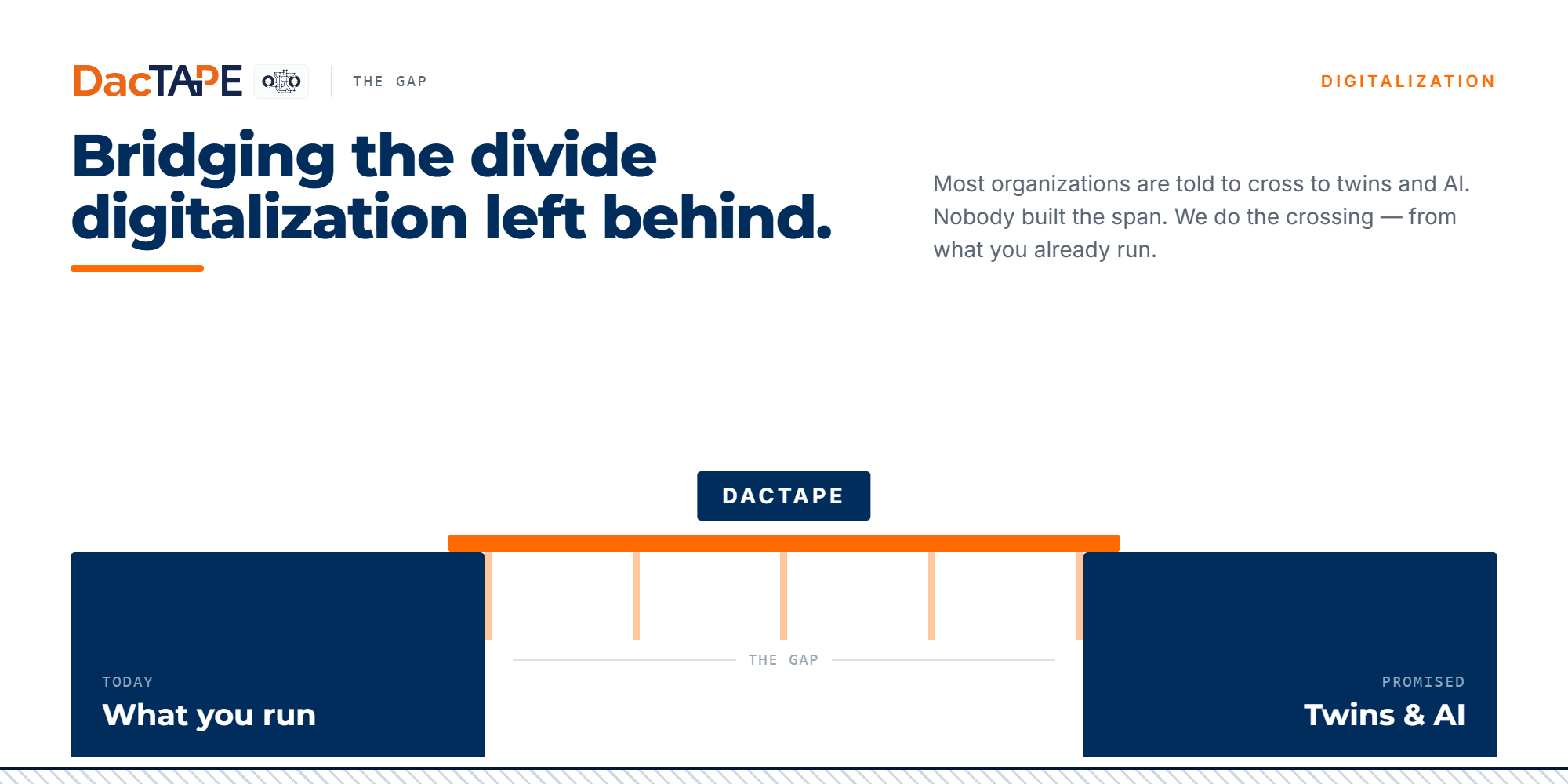
The Macro Reality: An Economy of Micro-Maturities
Enterprise technology narratives often assume a uniform operating environment: modern ERPs, standardized IoT telemetry, clean data pipelines, and mature technical teams.
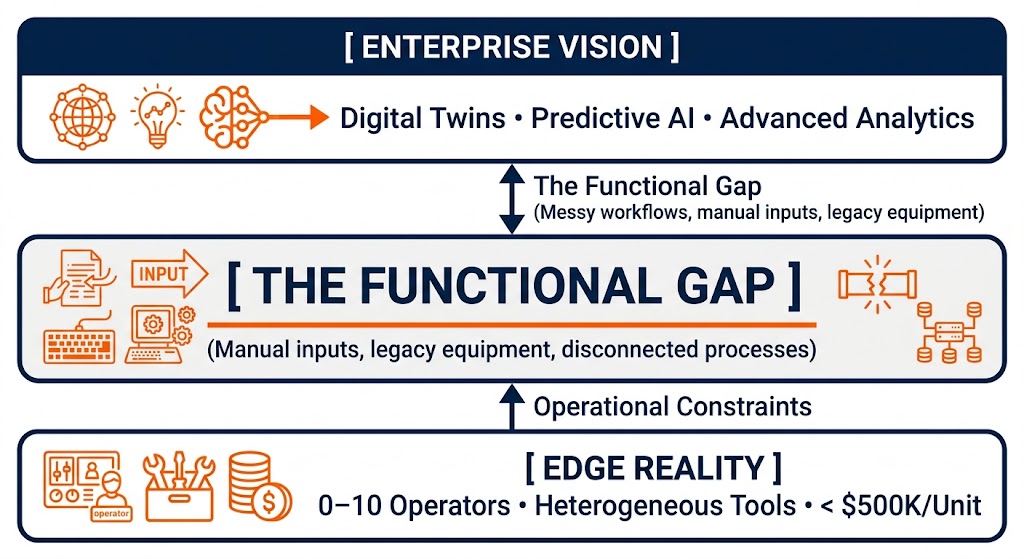
Organizations are not homogeneous in their digital maturity. Forcing complex digital twin architectures and advanced AI onto teams struggling with core operational workflows creates shelfware, operational fatigue, and inflated implementation costs.
To capture enterprise-wide intelligence without drowning local sites in digital overhead, leadership must adopt a pragmatic, bottom-up architectural strategy.
The Executive Dilemma: Local Utility vs. Corporate Intelligence
Digital transformation initiatives typically stumble on a fundamental disconnect between site-level utility and corporate intelligence demands:
| Dimension | Edge & Site Operations | Corporate Leadership & AI Teams |
| Primary Need | Immediate workflow relief, fast execution, low friction | Standardized telemetry, auditability, predictive modeling |
| Operating Environment | Legacy machines, ad-hoc spreadsheets, small teams | Cloud platforms, centralized data lakes, BI dashboards |
| Failure Mode | Systems too complex to use; data entry abandoned | "Garbage in, garbage out" models; zero visibility into edge reality |
When corporate rollouts demand clean data without providing daily operational value to the operator, compliance collapses. If a system does not immediately solve a local site’s operational bottleneck, it will never feed the enterprise AI engine.
DacTAPE: The Functional Layer Before the Digital Twin
Advanced AI models and digital twins are not standalone solutions; they are consumers of structured operational context. Without an underlying mechanism that captures reality as work happens, a digital twin is merely a static visualization.
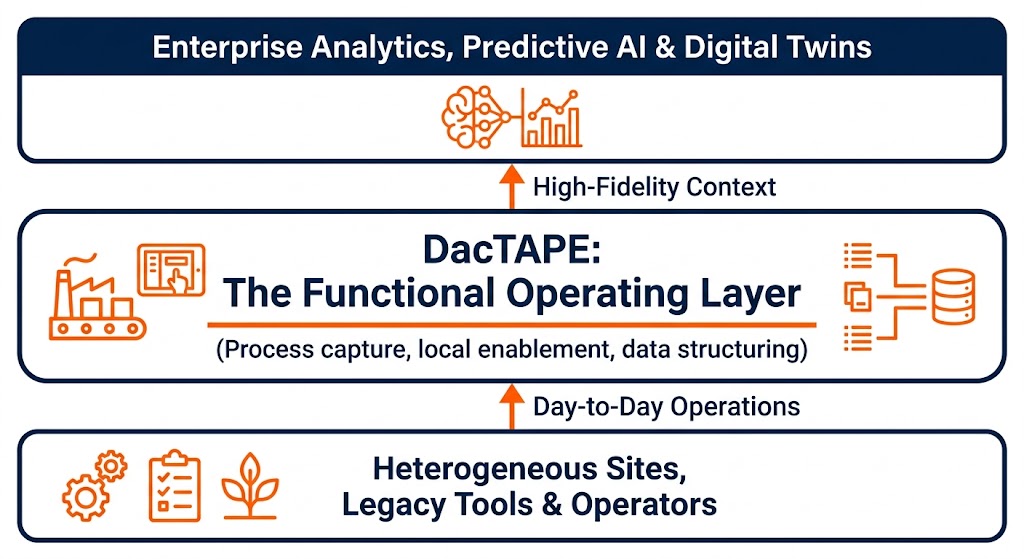
How DacTAPE Resolves the Maturity Gap:
Lightweight Enablement
Instead of requiring multi-year ERP overhauls or costly sensor retrofits, DacTAPE provides intuitive, low-overhead workflows tailored for 5-to-10 person operating units. It delivers day-one operational utility to the frontline operator, ensuring voluntary, high-frequency adoption.Automated Operational Structuring
DacTAPE standardizes messy, real-world interactions at the point of execution. Human workflows, legacy equipment cycles, and ad-hoc interventions are systematically captured and contextualized without adding administrative overhead.Feeding High-Fidelity Context to Corporate AI
By functioning as the operating substrate, DacTAPE converts day-to-day site execution into machine-readable data streams. This provides digital twins and enterprise AI models with real-world contextual grounding—eliminating blind spots and data silos.
Strategic Roadmap for Executive Leadership
Meet Every Unit at Its Current Maturity Level
Stop designing digital initiatives solely for flagship facilities. Define baseline digital standards that can be executed by a 5-person maintenance depot or a legacy manufacturing line.
Prioritize the Functional Layer Before Analytics Investment
Before procuring complex 3D twin platforms or generative AI copilots, ensure an operational capture layer like DacTAPE is actively managing and structuring workflows.
Align Frontline Incentives with Corporate Objectives
Ensure that every digital input required for corporate reporting simultaneously removes a manual task, reduces a bottleneck, or eliminates a headache for the frontline worker.
Organizations will never achieve uniform operational maturity across all sites and units- and they do not need to. By deploying DacTAPE as the functional bridge, leadership can empower small, diverse operational teams to succeed on their own terms while systematically building the data foundation required for enterprise-wide digital twins and AI.